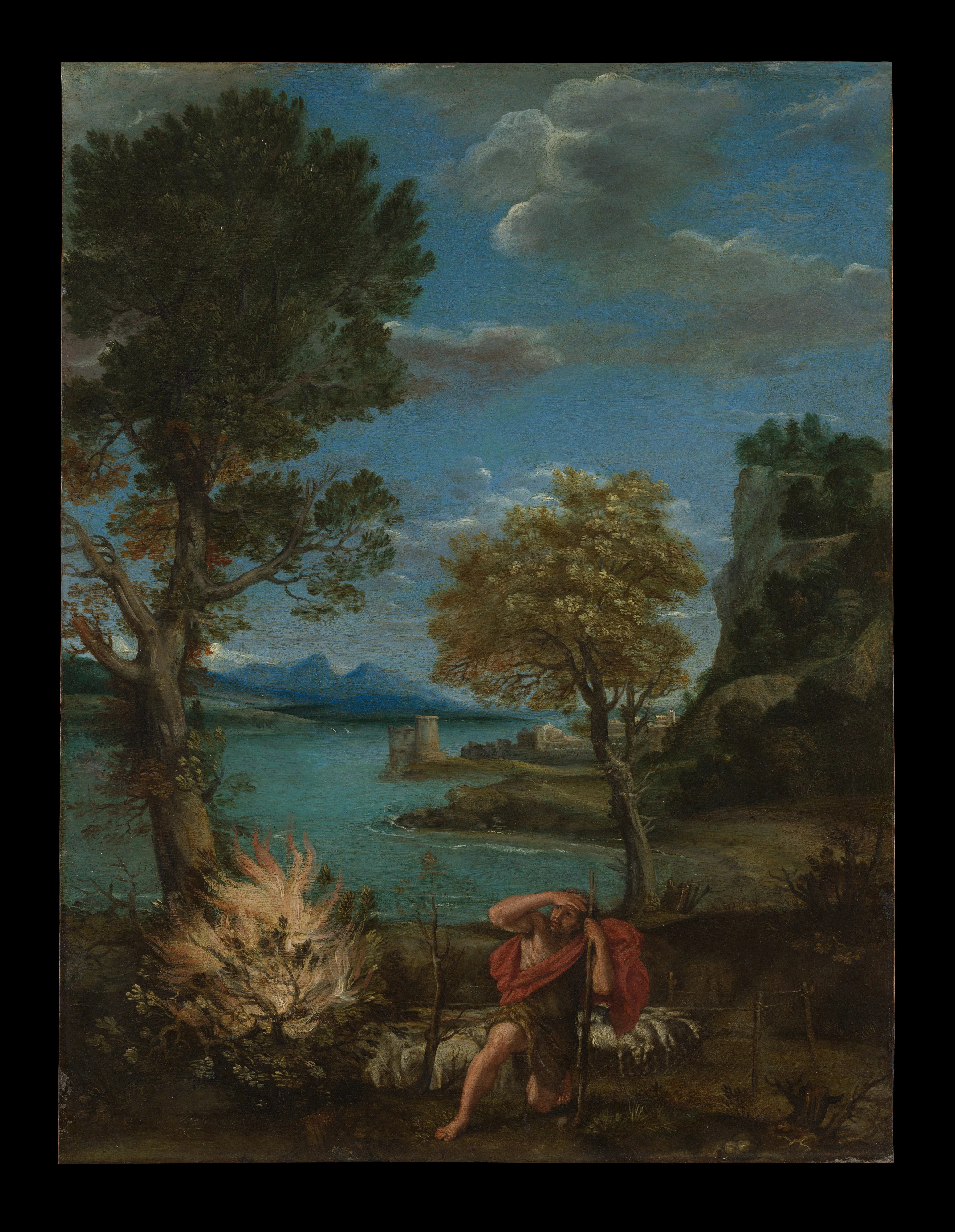
Painted between 1610 and 1616, this work depicts the biblical episode in which God reveals himself to Moses through a bush that burns without being consumed, as described in the Book of Exodus (Ex 3:1–6). While tending his father-in-law's flock near Mount Horeb, Moses witnessed this extraordinary phenomenon and heard the voice of God, who commanded him to remove his sandals because he was standing on holy ground. During this encounter, he received the mission to free the Israelites from slavery in Egypt. Domenichino presents the event within a vast idealized landscape, where nature occupies considerably more space than the biblical figure, a characteristic of his painting influenced by the classicism of Annibale Carracci. An interesting historical detail is that the work formed a pair with Landscape with Tobias Laying Hold of the Fish, now in the National Gallery in London. Both paintings, executed on copper panels of similar dimensions, were recorded together in a 1679 inventory of the Colonna family collection in Rome. According to the National Gallery, the episodes also carried meanings associated with the Virgin Mary in Renaissance Christian interpretation: the bush that burned without being consumed was associated with her Immaculate Conception.
Pintada entre 1610 e 1616, a obra representa o episódio bíblico em que Deus se manifesta a Moisés por meio de uma sarça que ardia em chamas sem se consumir, conforme narrado no livro do Êxodo (Ex 3, 1-6). Enquanto cuidava do rebanho de seu sogro, nas proximidades do monte Horeb, Moisés testemunhou esse fenômeno extraordinário e ouviu a voz de Deus, que lhe ordenou retirar as sandálias, pois estava em terra santa. Naquele encontro, recebeu a missão de libertar os israelitas da escravidão no Egito. Domenichino apresenta o acontecimento em uma vasta paisagem idealizada, na qual a natureza ocupa muito mais espaço que o personagem bíblico, característica de sua pintura influenciada pelo classicismo de Annibale Carracci. Um detalhe histórico interessante é que a obra formava um par com Paisagem com Tobias Capturando o Peixe, atualmente na National Gallery de Londres. As duas pinturas, executadas sobre placas de cobre de dimensões semelhantes, aparecem juntas em um inventário de 1679 da coleção da família Colonna, em Roma. Segundo a National Gallery, os episódios também possuíam significados relacionados à Virgem Maria na interpretação cristã do Renascimento: a sarça que ardia sem se consumir era associada à sua Imaculada Conceição.
Pintada entre 1610 y 1616, esta obra representa el episodio bíblico en el que Dios se manifiesta a Moisés a través de una zarza que ardía en llamas sin consumirse, según se narra en el libro del Éxodo (Ex 3, 1-6). Mientras cuidaba el rebaño de su suegro, cerca del monte Horeb, Moisés presenció este fenómeno extraordinario y escuchó la voz de Dios, que le ordenó quitarse las sandalias porque se encontraba en tierra santa. Durante aquel encuentro, recibió la misión de liberar a los israelitas de la esclavitud en Egipto. Domenichino presenta el acontecimiento en un vasto paisaje idealizado, donde la naturaleza ocupa mucho más espacio que el personaje bíblico, característica de su pintura influida por el clasicismo de Annibale Carracci. Un detalle histórico interesante es que la obra formaba pareja con Paisaje con Tobías capturando el pez, conservada actualmente en la National Gallery de Londres. Ambas pinturas, realizadas sobre planchas de cobre de dimensiones semejantes, aparecen juntas en un inventario de 1679 de la colección de la familia Colonna, en Roma. Según la National Gallery, los episodios también tenían significados relacionados con la Virgen María en la interpretación cristiana del Renacimiento: la zarza que ardía sin consumirse se asociaba con su Inmaculada Concepción.