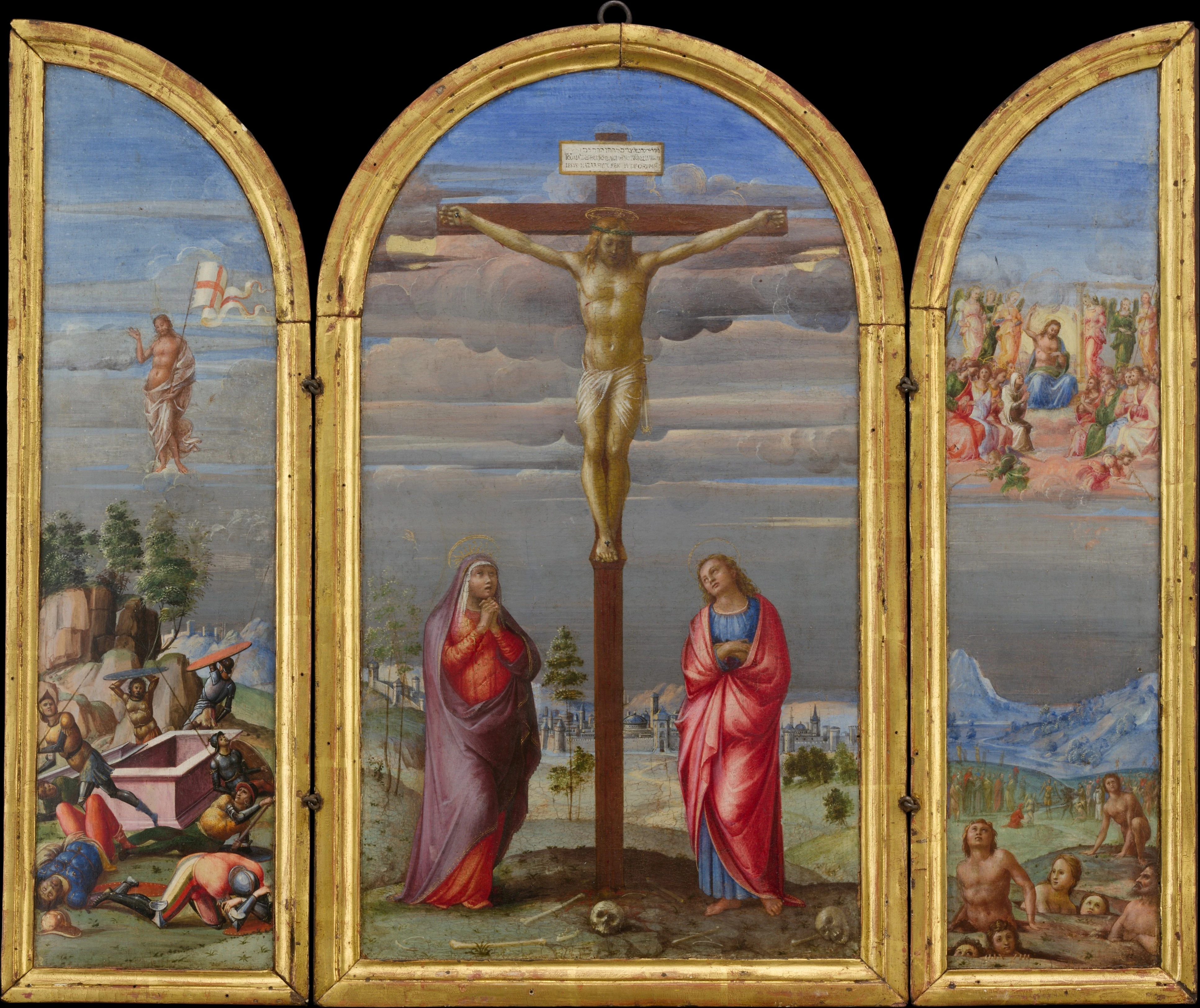
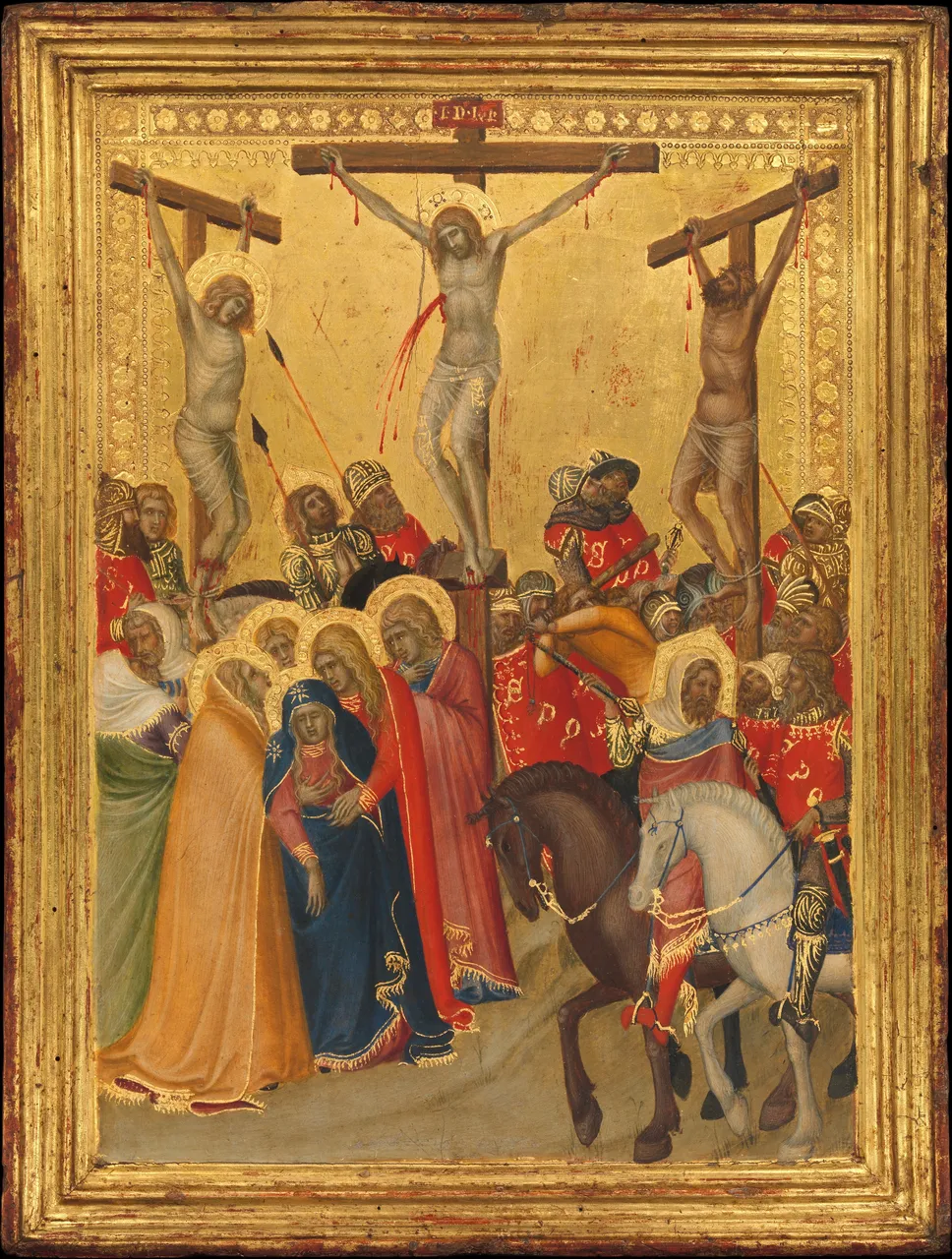
Painted around 1510, this portable triptych brings together three central events of the Christian faith: Jesus' death on the cross, his Resurrection, and the Last Judgment. In the central panel, the crucified Christ is accompanied by the Virgin Mary and Saint John the Evangelist, while the side wings depict the risen Jesus and the soldiers near the empty tomb on the left, and Christ as Judge, surrounded by the heavenly court, with the dead rising for judgment on the right. An interesting detail is the inscription above the cross, presenting the title "Jesus Christ, King of the Jews" in Hebrew, Greek, and Latin, as described in the Gospel of Saint John (Jn 19:19–20). In the Last Judgment scene, one of the resurrected figures looks directly at the viewer, symbolically drawing them into the event. Intended for private devotion, the painting could be easily closed and transported. Although produced during the High Renaissance, its structure revives a triptych format popular in Tuscany about a century earlier, while its continuous landscape reveals influences from Northern European painting. An old inventory label on the reverse indicates that the work once belonged to the Florentine Stiozzi Ridolfi family.
Pintado por volta de 1510, este tríptico portátil reúne três acontecimentos centrais da fé cristã: a morte de Jesus na cruz, sua Ressurreição e o Juízo Final. No painel central, Cristo crucificado é acompanhado pela Virgem Maria e por São João Evangelista, enquanto as portas laterais apresentam, à esquerda, Jesus ressuscitado e os soldados junto ao sepulcro vazio; à direita, Cristo como Juiz, cercado pela corte celestial, e os mortos ressuscitando para o julgamento. Um detalhe interessante está na inscrição acima da cruz, que apresenta o título "Jesus Cristo, Rei dos Judeus" em hebraico, grego e latim, conforme o Evangelho de São João (Jo 19, 19-20). Na cena do Juízo Final, uma das pessoas que ressuscitam olha diretamente para o observador, envolvendo-o simbolicamente no acontecimento. Destinada à devoção particular, a pintura podia ser fechada e transportada facilmente. Embora produzida durante o Alto Renascimento, sua estrutura retoma um modelo de tríptico popular na Toscana cerca de um século antes, enquanto a paisagem contínua revela influências da pintura do norte da Europa. Um antigo rótulo de inventário no verso indica que a obra pertenceu à família florentina Stiozzi Ridolfi.
Pintado hacia 1510, este tríptico portátil reúne tres acontecimientos centrales de la fe cristiana: la muerte de Jesús en la cruz, su Resurrección y el Juicio Final. En el panel central, Cristo crucificado está acompañado por la Virgen María y san Juan Evangelista, mientras que las puertas laterales representan, a la izquierda, a Jesús resucitado y a los soldados junto al sepulcro vacío; a la derecha, a Cristo como Juez, rodeado por la corte celestial, y a los muertos resucitando para el juicio. Un detalle interesante es la inscripción sobre la cruz, que presenta el título "Jesucristo, Rey de los Judíos" en hebreo, griego y latín, según el Evangelio de san Juan (Jn 19, 19-20). En la escena del Juicio Final, una de las personas que resucitan mira directamente al espectador, involucrándolo simbólicamente en el acontecimiento. Destinada a la devoción privada, la pintura podía cerrarse y transportarse fácilmente. Aunque fue realizada durante el Alto Renacimiento, su estructura recupera un modelo de tríptico popular en Toscana aproximadamente un siglo antes, mientras que el paisaje continuo revela influencias de la pintura del norte de Europa. Una antigua etiqueta de inventario en el reverso indica que la obra perteneció a la familia florentina Stiozzi Ridolfi.